


Updated 24 July 2026
If your hand moves towards the treats before your dog performs the behaviour, the pouch—not your cue—can become the signal. The fix is simple: mark first, reach second.
A dog treat pouch does not train your dog by itself. Its real value is practical: it keeps rewards ready so you can identify the right behaviour, mark it clearly and deliver reinforcement promptly. Used well, it also keeps food out of sight until your dog has earned it.
Quick answer: how to use a dog treat pouch
- Pre-portion small, easy-to-eat rewards.
- Wear the pouch where your free hand can reach it without twisting.
- Keep both hands quiet while you give the cue or wait for the behaviour.
- Mark the correct moment with a click or a consistent word such as “yes”.
- Only then reach into the pouch and deliver the reward promptly.
- Reset your hand outside the pouch before the next repetition.
This guide uses Australian English and reward-based methods supported by RSPCA Australia and the American Veterinary Society of Animal Behavior. For persistent fear, reactivity, aggression or other complex behaviour, ask your veterinarian for an appropriately qualified reward-based professional.
In this guide
Why Reward Timing Matters in Dog Training
Reward-based training works when a consequence your dog values—food, play, access to sniffing or another reward—makes a behaviour more likely to happen again. The closer and clearer the connection, the easier the lesson is to understand.
A marker helps identify the exact moment. It can be a clicker or a short, consistent word. The marker is not the reward itself; it tells your dog which action is about to pay. Current evidence does not show that a clicker is universally better than a verbal marker, so use the option you can deliver consistently.
The pouch improves your mechanics. It removes the delay of opening a packet or searching a pocket, while allowing your hands to stay neutral until after the marker. It has not been scientifically proven to make dogs learn faster on its own.
What to Put in a Dog Treat Pouch
Choose rewards according to the dog and the difficulty of the task. A biscuit that works in the kitchen may not compete with birds, dogs or new smells at the park.
- For easy repetitions: use part of your dog’s measured daily kibble if it motivates them.
- For new or difficult work: use a small amount of a higher-value, dog-safe reward.
- For fast sessions: choose very small pieces that can be eaten quickly. AVSAB suggests pieces no larger than a little-fingernail, and smaller again for small dogs.
- For warm walks: shelf-stable rewards are usually more practical than moist food left sitting in a pouch.
Treats still count as food. The World Small Animal Veterinary Association advises that treats should make up less than 10% of a dog’s daily calories. That is an upper limit, not a target, and it refers to calories—not the number, weight or volume of treats. Puppies, dogs on prescription diets and dogs with allergies, pancreatitis, kidney disease or weight concerns need individual veterinary advice.
Practical calorie shortcut: measure the day’s training allowance before you leave home. For frequent easy repetitions, use some of the dog’s normal complete food and reserve a few higher-value pieces for the hardest moments.
How to Wear and Set Up Your Treat Pouch
- Load only the session amount. Overfilling makes the pouch slower to use and makes portions harder to track.
- Keep food separate. Use the food compartment for rewards and zipped pockets for keys, cards or waste bags.
- Place it on the reward side. For loose-lead practice, wear it where the hand nearest your dog can reach comfortably. If you switch walking sides, a centred waist position may be easier.
- Keep it outside the dog’s direct nose line. The pouch should stay secure rather than swinging or sitting where your dog can self-serve.
- Test the closure. You should be able to take one treat and close the pouch with one hand.
Before involving your dog, practise ten repetitions with dry kibble: say your marker, pause, take one piece, deliver it to a chosen spot and return your hand to neutral. This separates the marker from the rustle and reach of the pouch.
The Mark–Reach–Reward–Reset Method
1. Mark
Watch for the exact behaviour you want. The instant it happens, click or say your chosen marker. Your hands stay still until this point.
2. Reach
After the marker, move your hand to the pouch. If you reach first, your dog may learn to wait for the hand movement instead of listening to the cue.
3. Reward
Deliver a small reward promptly—generally within about one or two seconds of the marker. Placement matters: reward beside your leg for walking position, between the paws for settling, or close to your body after recall.
4. Reset
Move your hand out of the pouch, secure the opening and begin the next repetition with neutral hands. Short, clear rounds are usually more useful than a long session in which timing becomes sloppy.
Using a Treat Pouch for Recall, Loose-Lead Walking and Puppy Training
Recall practice
- Start at home or in another low-distraction area.
- Use the recall cue once.
- Mark when your dog commits to turning and moving towards you.
- Reward generously when they arrive close to you.
- Sometimes release them to explore again so returning does not always end the fun.
Move to harder environments gradually and use a long line in open, unsecured areas. A pouch makes the reward accessible; it does not create a 100% reliable recall or make off-lead work safe near roads. RSPCA Australia’s recall guidance recommends ongoing practice and rewards.
Loose-lead walking
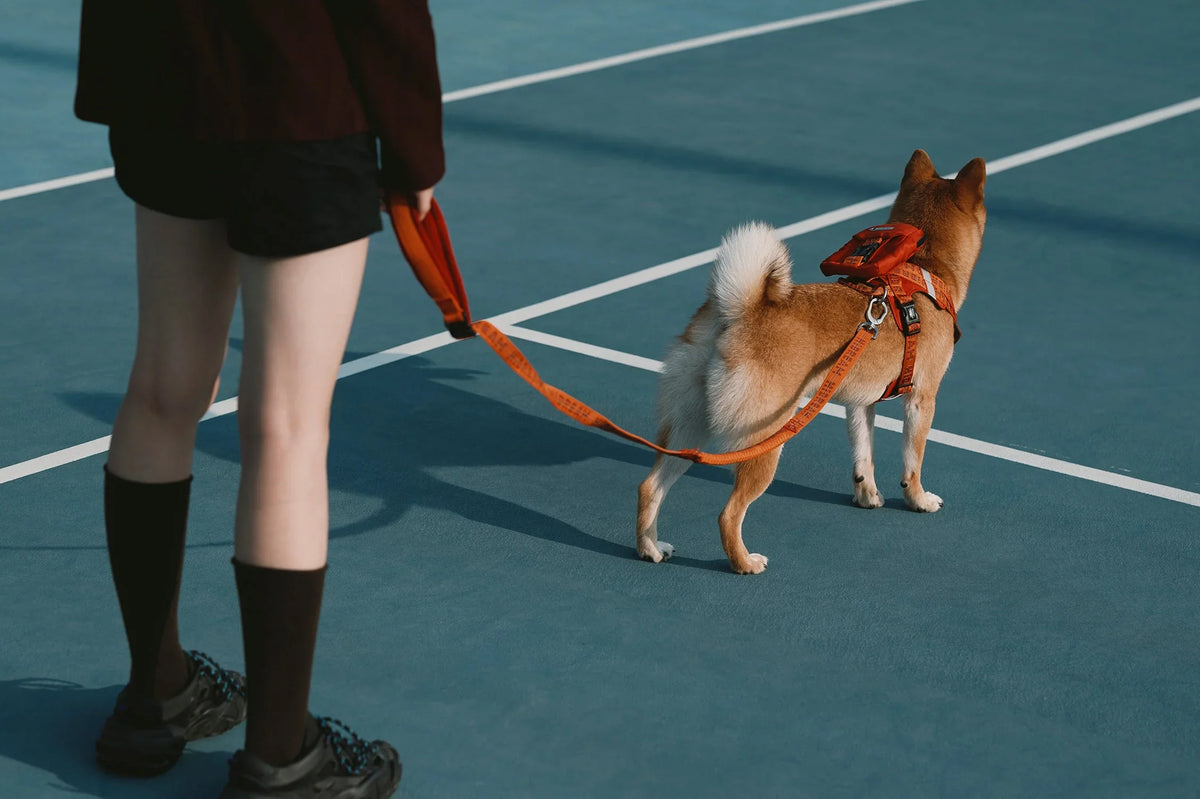
Choose one clear criterion, such as a slack lead or your dog walking within a comfortable area beside you. Mark that moment, then deliver the reward where you want the dog to remain. In early sessions, that may mean rewarding every few steps.
If the lead tightens, stop rather than jerking the lead. Continue when slack returns, so both food and forward movement reinforce loose-lead walking. Pair this with well-fitted walking equipment; see our dog harness selection guide and step-by-step harness training guide.
Puppy and everyday manners
Keep the pouch ready for behaviours that are easy to miss: four paws on the floor, choosing to settle, responding to a name, toileting in the right place or calmly watching a distraction. Mark the behaviour as it happens; do not wait until you have returned inside or moved on to something else.
How to Stop Pouch Staring, Jumping and Mugging
A dog staring at the treat bag is not being manipulative. They may simply have learned that a hand moving towards the pouch predicts food.
- Keep the pouch closed between repetitions.
- Keep your hands still before the marker. Ask for an easy, familiar behaviour with empty hands.
- Mark attention away from the pouch. When your dog looks back to you or offers the requested position, mark first and then reach.
- Do not reward self-service. If a nose enters the pouch or the dog jumps, calmly close it and reset. Reward four paws on the ground rather than pushing, kneeing or scolding.
- Reduce the difficulty. If your dog cannot disengage, create more distance from distractions, use less-arousing food or shorten the session.
If a dog stops accepting a normally valued reward, the environment may be too stressful or distracting. Move farther away and make the task easier instead of assuming the dog is stubborn or simply reaching for a more exciting treat.
Food as a Consequence, Not a Preview
A visible treat can be a useful temporary lure when introducing a movement. It becomes a problem when the dog only responds after seeing the food.
Once the movement is understood, put the food in the pouch, give the cue with empty hands and produce the reward only after the behaviour. This turns the treat from a preview into a consequence. AVSAB’s explanation of fading visible food lures follows the same principle.
Do not remove reinforcement abruptly. When a behaviour is fluent, mix food with praise, play, permission to sniff, opening a door or continuing the walk. Keep high-value food for new skills, difficult environments and especially important responses such as recall.
How to Choose the Right Dog Treat Pouch
The best closure depends on where and how you train:
- Magnetic closure: quickest for repeated one-handed access; check that it closes securely around your dog and during active movement.
- Drawstring closure: can cinch more tightly for running or crumbly treats, but usually takes longer to open and close.
- Waist, clip or crossbody wear: choose the position that stays stable and lets your non-lead hand reach naturally.
- Food-only lining: look for a surface you can wipe or wash according to the care label.
- Separate storage: keep phones, keys and used waste bags away from treats.

Two HiDREAM options
The Toast Dog Training Treat Pouch measures 16 × 6 × 16 cm and uses a 16 cm dual-magnetic opening for one-handed access. It can be worn at the waist, crossbody or with its rear belt clip, and includes separate phone, card and waste-bag storage. Its water-resistant nylon exterior is not fully waterproof; wipe it with a damp cloth and dry thoroughly rather than machine-washing it.
For a simpler adjustable waist-belt option with an easy-clean lining, compare the Pet Training Treat Pouches. Check the selected option and current care instructions before ordering.
How to Clean and Store a Treat Pouch
- Empty crumbs and leftover food after every session.
- Use a removable food-only liner for moist or cooked rewards, then wash and dry that liner after use.
- Follow the product care label; wiping, hand-washing and machine-washing are not interchangeable.
- Let the pouch dry completely before refilling it.
- Wash your hands before and after handling dog food.
- Do not leave raw or perishable food sitting in a standard pouch. RSPCA Australia does not recommend feeding raw meat because of bacterial risks to dogs and people.
Dog Treat Pouch FAQs
Where should I wear a dog treat pouch?
Wear it where your free hand can reach quickly without crossing your body. For walking practice, that is often on the same side as the dog. Keep it secure and away from the dog’s direct nose line.
Can I use kibble in a treat pouch?
Yes, if your dog values it. Set aside part of the measured daily food for easy repetitions, and use a small amount of higher-value food when the environment or task is harder.
How many treats should I carry?
Carry the amount planned for that session, not a full bag by default. Keep all treats within the dog’s daily calorie plan; less than 10% of daily calories is a general upper limit for healthy adult dogs, not a target for every dog.
Is a magnetic or drawstring pouch better?
Magnetic closures favour fast one-handed access. Drawstrings favour a tighter cinch during active movement. The better choice is the one you can operate smoothly while keeping food secure.
Should I stop using treats once my dog knows the cue?
Do not stop reinforcement suddenly. Gradually use a wider mix of rewards, while continuing to use food for new behaviours, difficult distractions and responses that need strong maintenance.
Why does my dog only listen when I wear the pouch?
The visible pouch or your reaching motion may have become part of the cue. Practise familiar behaviours with empty hands, mark before reaching and sometimes deliver rewards from another prepared location. The aim is for the verbal or visual cue—not visible food—to predict the opportunity to earn a reward.
Bottom Line
A useful treat pouch improves the human side of training: preparation, timing and consistency. Remember the order—behaviour, marker, reach, reward, reset—and the pouch becomes a quiet tool rather than the centre of your dog’s attention.
Compare our one-handed magnetic training pouch, browse the Pet Care collection, and choose the setup that matches your dog, your rewards and your training routine.
Sources and Further Reading
- RSPCA Australia: Reward-based dog training
- AVSAB: Humane Dog Training Position Statement
- AVSAB: An Introduction to Positive Reinforcement
- Dogs Australia: Tricks and Treats
- RSPCA Australia: Teaching recall
- RSPCA Australia: Loose-lead walking equipment and method
- WSAVA: Feeding Treats to Your Dog
This article provides general education, not individual veterinary or behavioural advice.